If you’ve read A Tale of Two Cities (I just finished it for the first time, catching up on English Lit I missed the first time ‘round), you’re familiar with Madame Defarge, the proprietress of a Parisian tavern that’s secretly a hub of revolutionary activity. She’s constantly knitting but “sees nothing,” or so we’re told to assume. In reality, her stitches hold secret codes: undercover agents, meeting times and dates, plans to storm the Bastille. As a knitter myself, I had to know: was this true? Did knits and purls become secret communiques?
The answer is, sort of.
[Image from Modern Daily Knitting]
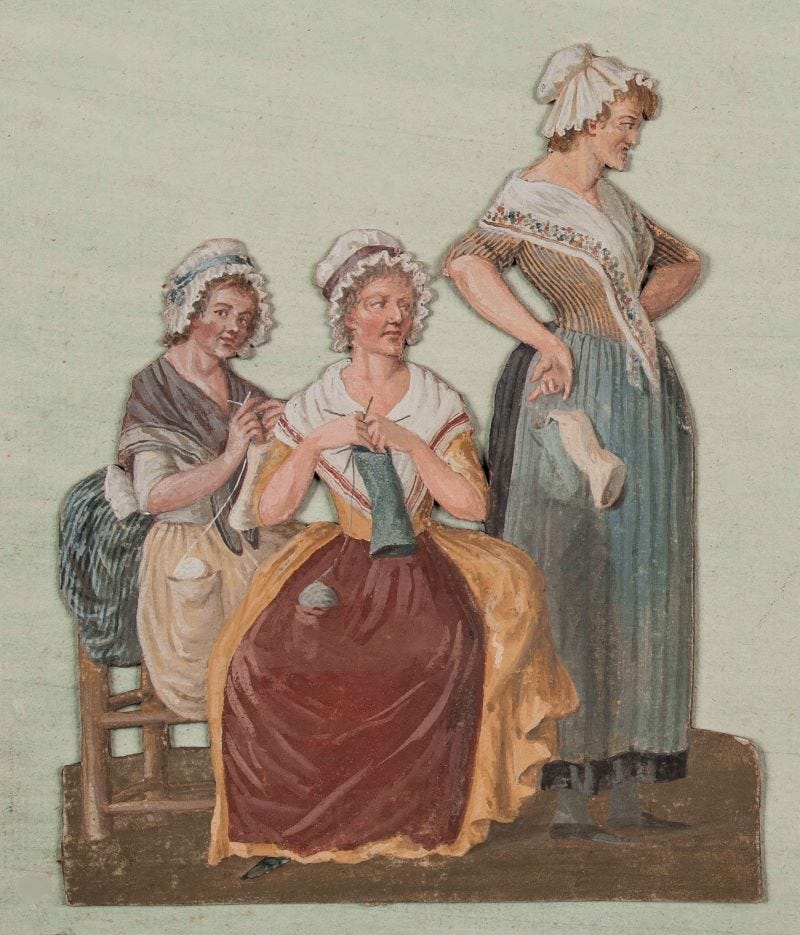
According to Carol J. Sulcoski’s article “Knitting Spies” on Modern Daily Knitting, Madame Defarge’s character was based on “the real tricoteuses—women who knitted while sitting in revolutionary councils and, later, while watching executions by guillotine.” But although the article goes on to describe several other knitting spies throughout the ages (which I’ll come back to) it doesn’t mention whether the tricoteuses kept lists of the damned in their knitwear.
So I checked out Loretta Napoleoni’s article “On the Covert Role of Knitting During the French Revolution and World War II” on Literary Hub. According to Napoleoni, the French Revolution was sparked by organized groups of market women marching on Versailles, and once the fighting was underway these women “walked the streets of Paris insulting whoever they thought was wealthy and encouraging the revolutionaries to arrest them.” We see this reflected in Madame Defarge’s character about halfway through the book when she helps decide who gets sent to the guillotine and who doesn’t, often based on personal grudges and favors slipped into her coffers.
In real life, according to Napoleoni, the nascent French revolutionary government felt threatened by the tricoteuses’ “political role, rising power, and popularity within the Revolution” and sidelined them from official meetings and assemblies. Undeterred, the women took their knitting to the Place de la Révolution where they sold red hats (see my last post!), socks, and mittens as well as coveted front-row seats to la guillotine. The queasy image of merch tables at public executions has lingered even longer than what the knitting itself might’ve conveyed.
But were the tricoteuses actually spies? Napoleoni concludes they weren’t because working-class women of the time were unlikely to read or write, much less “encode[d] the names of the executed aristocrats in their knitting, as Dickens claimed they had.” I would argue that the co-manager of a wine shop like Madame Defarge would probably have had some literacy and bookkeeping skills, and real-life spies might not need to read and write to encode messages in what’s essentially a binary system. Knitting is made up of two stitches, knits and purls, which could convey plenty of information through prearranged codes that didn’t depend on the alphabet.
For example, numerical information is easy to share. Naomi Parkhurst of Gannet Designs demonstrates over a series of posts how she knits meaningful dates into knitwear (an anniversary into a shawl) or converts words to numbers and creates a pattern around that. The only restriction would be that knitter and recipient know the code.
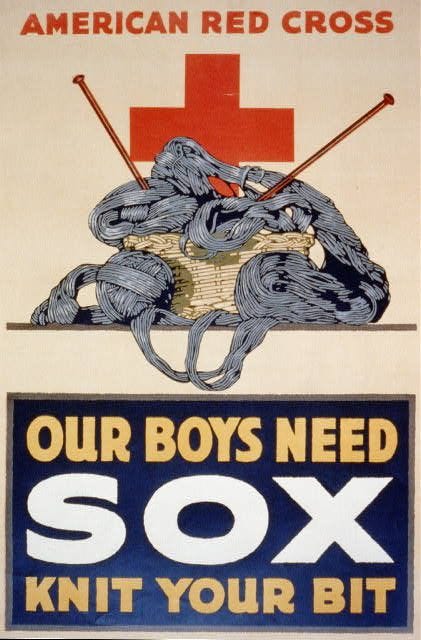
[A World War One poster to promote knitting for soldiers. Library of Congress/LC-USZC2-670]
Fast-forward to WWI when several documented spies used knitting to do just that. In Natalie Zarrelli’s “The Wartime Spies Who Used Knitting as an Espionage Tool” from Atlas Obscura, secret messages conveyed through knitting were “a form of steganography, a way to hide a message physically.” She quotes Lucy Adlington’s book Stitches in Time, about a 1918 article in UK Pearson’s Magazine that reported Germans were knitting sweaters with hidden messages:
“When the German authorities carefully unraveled such a sweater, the story went, they found the wool thread dotted with many knots. By marking a vertical door frame with the letters of the alphabet, spaced an inch apart, the knots could be deciphered as words by measuring the yarn along this alphabet and marking which letters the knots touched.”
Zarrelli also shares an exciting story from Phyllis “Pippa” Latour Doyle, a secret agent for Britain during WWII, who parachuted into occupied Normandy in 1944 and chatted up troops and German soldiers disguised as a poor French girl. As Doyle told New Zealand Army News in 2009:
“I always carried knitting because my codes were on a piece of silk—I had about 2000 I could use. When I used a code I would just pinprick it to indicate it had gone. I wrapped the piece of silk around a knitting needle and put it in a flat shoe lace which I used to tie my hair up. … I can remember being taken to the station and a female soldier made us take our clothes off to see if we were hiding anything. She was looking suspiciously at my hair so I just pulled my lace off and shook my head. That seemed to satisfy her. I tied my hair back up with the lace—it was a nerve-wracking moment.”
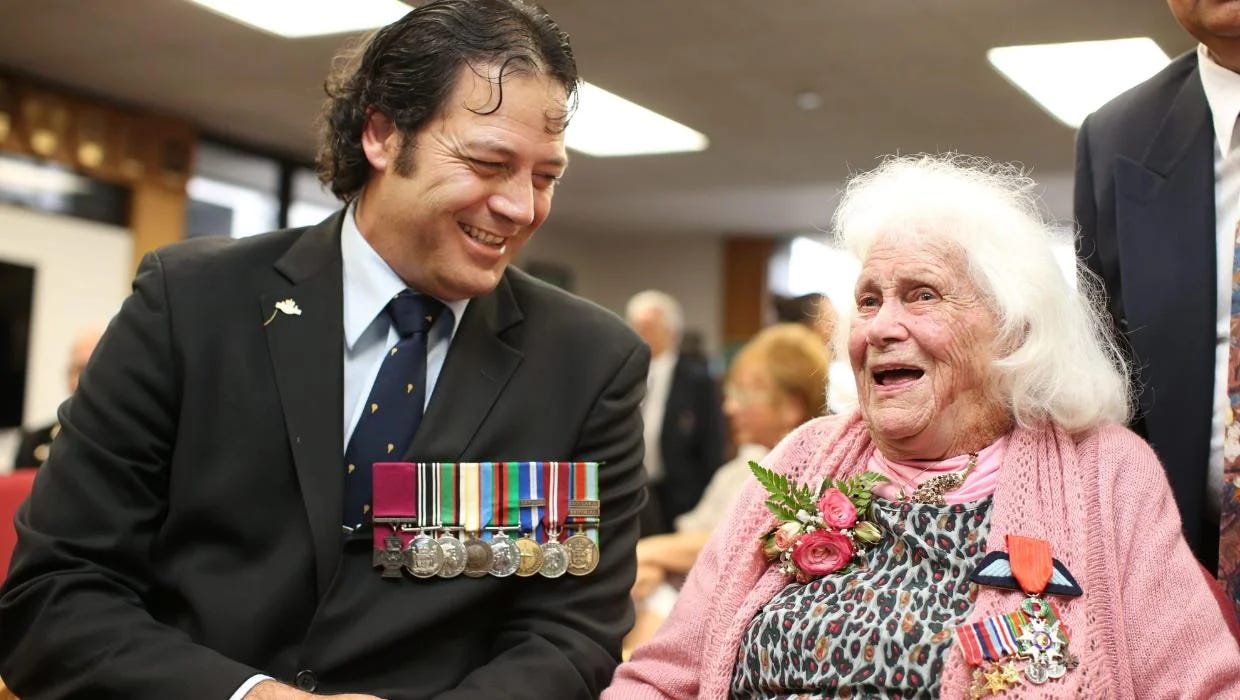
[HERO MEETS A HERO: Victoria cross recipient Willie Apiata meets with Pippa Doyle before she received the Legion of honour Medal for her exploits during World War II. Photo: DAVID WHITE / Fairfax NZ]
So the next time you see a sweet-looking person with a pair of knitting needles, be careful about divulging secrets. They might be taking notes. And if you’re a knitter, consider including messages in your next project. Who doesn’t love a bit of spycraft to keep warm?